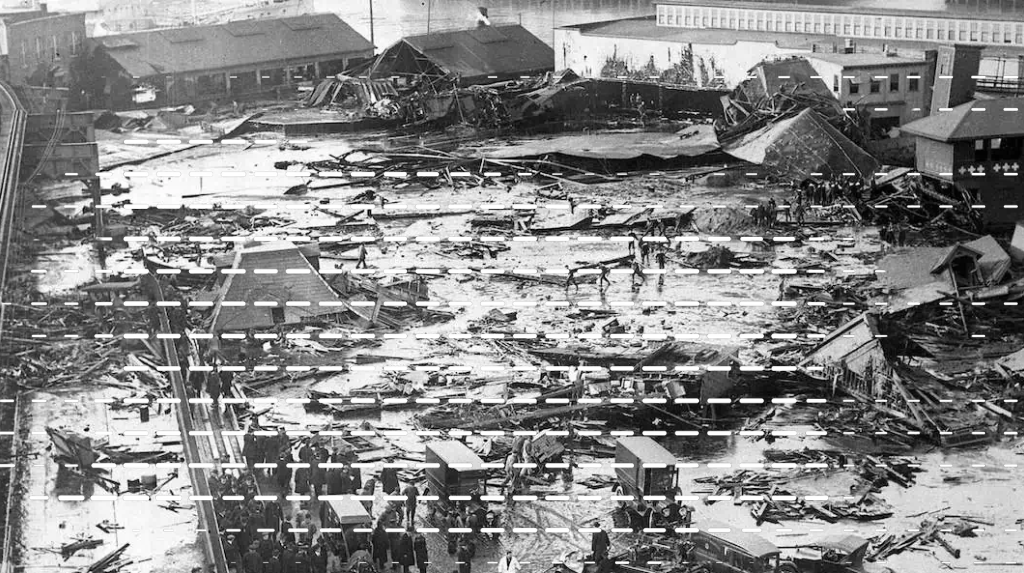


A Tank That Should Never Have Been Built
On January 15, 1919, on a winter afternoon that was mild for Boston, residents of the North End heard a sound like a series of machine-gun fire. The rivets of a 50-foot steel tank standing right by the waterfront were snapping. Seconds later, a wave of molasses 25 feet high and 165 feet wide surged into the streets, traveling at 35 mph.
It is one of the best-documented industrial disasters in U.S. history—a legal investigation that forever changed how engineers design industrial tanks.
The United States Industrial Alcohol Company (through its subsidiary, Purity Distilling) erected the tank in 1915 to store molasses arriving by ship from the Caribbean—Puerto Rico, Cuba, and the West Indies. It was sent to a nearby distillery to be processed into industrial alcohol. During World War I, this was a raw material for munitions. After the war, the company pivoted to another equally profitable goal: producing spirits for industry—before it became illegal.
The tank was 50 feet tall and held 2.3 million gallons of molasses. The problem was that it leaked from the very beginning. Local children would come with pails and scrapers to collect the dripping molasses to take home—it was a treat for them. The tank would groan when full. No one formally investigated it because, as was later determined, the structure did not require a building permit at all, as it was legally classified as a simple storage vessel.
The leak test conducted by the company before the facility went online was supervised by Arthur Jell—a man with no engineering education. Post-accident investigations (including a 2014 engineering analysis by Ronald Mayville) revealed that the steel used to build the tank was half as thick as required by the already lenient standards of the 1910s, and its chemical composition was low in manganese—an element crucial for the strength and resistance of steel to brittle fracture in cold temperatures.
A Race Against Time
On January 16, 1919—the day after the disaster—the 18th Amendment to the U.S. Constitution, which introduced Prohibition, was set to be ratified. For US Industrial Alcohol, this meant the end of legal alcohol production on its current scale. Aware of the looming deadline, the company had been maximizing molasses processing for weeks; the tank was being filled faster and fuller than usual to process as much raw material as possible.
On January 12, a fresh, warm batch of molasses from Puerto Rico was added to the tank—warmer than what was already inside. The temperature difference between the layers accelerated fermentation and created additional pressure inside a structure that was already operating at its limit. Three days later, the rivets gave way.
The wave swept buildings off their foundations, overturned rail cars, and killed horses. 21 people died—many of them suffocated in the thick, hardening sludge before help could arrive. About 150 people were injured. Cleaning the streets took weeks, and Boston residents claimed the smell of molasses lingered over the North End for years.
The Paradox: The Regulation Meant to Protect Accelerated the Disaster
The 18th Amendment—a piece of legislation intended to curb alcohol consumption and make America safer—indirectly led to one of the worst industrial disasters in the city's history. The time pressure before it took effect prompted the company to overload already faulty infrastructure rather than halt production and repair the tank.
The side effect proved more lasting than Prohibition itself. The civil lawsuit filed against the company by 119 victims and their families was one of the first in U.S. history to use expert witnesses—engineers and metallurgists—on such a large scale to analyze the causes of a technical failure. As summarized by historian Stephen Puleo, author of the definitive monograph Dark Tide: The Great Boston Molasses Flood of 1919: almost every modern building standard we take for granted today stems indirectly from this disaster. For the first time, the Boston Building Department began requiring that engineering and architectural calculations be submitted with project plans and signed by licensed professionals—a practice that later became the standard across the entire United States.
A Lesson for Modern Logistics
The 1919 pattern—where a company accelerates production and overloads infrastructure to meet a hard regulatory deadline—did not disappear with Prohibition. It remains one of the most recurring risk mechanisms in modern logistics.
We saw this during the hard Brexit at the turn of 2020 and 2021, when companies on both sides of the English Channel frantically leased extra warehouse space and stockpiled inventory "just in case" before January 1st, desperate to beat new customs procedures. Some of these hastily arranged warehouses and processes failed to meet the standards that would have been obvious under a normal investment pace. We see it every year during the e-commerce peak season, when distribution centers, under pressure from Black Friday and Christmas deadlines, cut corners on technical acceptance procedures for newly opened warehouses just to get them operational before November.
The mechanism is always the same: an upcoming deadline—whether regulatory, seasonal, or contractual—creates pressure where the cost of time (delays, downtime, contractual penalties) seems, in that moment, higher than the cost of technical risk. The story of the North End tank shows, quite brutally, that this calculation is almost always wrong. The cost of skimping on engineering, inspections, and safety margins—when it finally comes to light—proves to be many times higher than the cost of meeting standards from the start. The only difference is who pays for it and when.
Sources
- Stephen Puleo, Dark Tide: The Great Boston Molasses Flood of 1919 (reference monograph)
- NBC News, The Great Boston Molasses Flood of 1919 killed 21 after 2 million gallon tank erupted
- NPR, After 100 Years, A Look Back At Boston's Great Molasses Flood Of 1919
- Britannica, Great Molasses Flood
- WBUR, Remembering Boston's Deadly Molasses Flood, 100 Years Later
- Justin Harter, The Boston Molasses Flood of 1919 gave us modern building standards
- Fascinating World, The Great Molasses Flood Of 1919 (details of Ronald Mayville's 2014 engineering analysis)
Our previous publications from the "Dark Stories" series
- Why do we need FOB? - Dark Stories #1
- Really CIF? - Dark Stories #2
- EXW as my shield? - Dark Stories #3
- A ticking time bomb in hold number 4 - Dark Stories #4
- To copper or not to copper? - Dark Stories #5
- Your container is intact. You're still paying - Dark Stories #6
- Really DDP? - Dark Stories #7
- "Fake carrier fraud" - Dark Stories #8
- Not my wagon, not my fault? - Dark Stories #9
- How a loose cable sank a bridge and cost the shipowner $2.25 billion - Dark Stories #10
- Your cargo. Not your carrier - Dark Stories #11
- The evidence that went to the bottom - Dark Stories #12
- Concrete blocks at the price of copper - Dark Stories #13
- Pallet or parcel? - Dark Stories #14
- The shipowner paid the ransom. The bill still went to the cargo owner - Dark Stories #15
- The Yellow Fleet: eight years at a standstill, or how one war froze fifteen ships. - Dark Stories #16