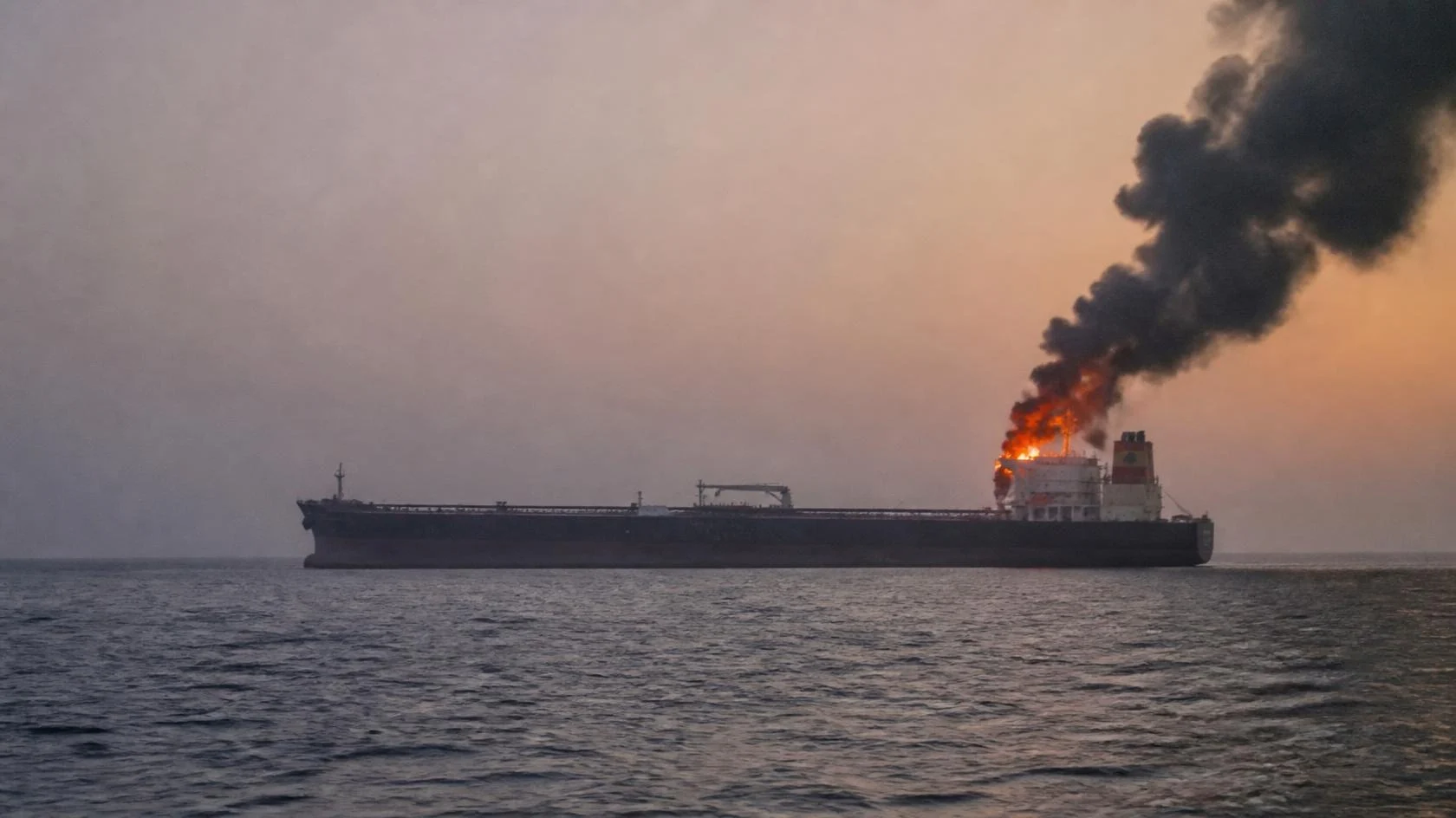


Gulf of Aden, the night of July 5–6, 2011.
Near Aden, off the coast of Yemen, armed men board the tanker Brillante Virtuoso. A fire breaks out on the ship. On July 6, the USS Philippine Sea rescues the crew from a lifeboat. The tanker is severely damaged.
At first glance, it appeared to be another attack in a region known for piracy. The ship was insured against war risks with an extension for piracy. The bank that financed it was a co-insured party. The reported attack seemed to fall under the piracy risk listed in the policy.
Eight years later, on October 7, 2019, a London court dismissed Piraeus Bank's claim for approximately $77 million. The bank was not at fault and had received about $64 million from separate insurance covering its interest as a mortgage lender. It lost the case for payment under the ship's war risk policy because the staged attack and arson did not fall under any named peril in the policy. And even if they had, the insurers would have won anyway: the policy conditions regarding navigation limits and anti-piracy protection had been breached.
Verdict after 52 days
The trial before the Commercial Court lasted 52 days. Justice Teare determined that the destruction of the ship was orchestrated by its beneficial owner, Marios Iliopoulos. The court also identified a motive: a $77 million payout would have resolved the serious financial difficulties faced by Iliopoulos and his companies.
The insurers' side included Hiscox, QBE, and Markel, among others. However, the most important sentence in the verdict concerns the bank, not the owner: "the bank is unable to establish that the loss was caused by an insured peril." The bank failed to prove that the damage was caused by a risk covered by the insurance.
The owning company was no longer pursuing its own claim at that point, although it remained a party to the insurers' counterclaim, which it did not defend. In 2016, Justice Flaux struck out the company's claim because Iliopoulos had breached a court order and lied to the court. The dispute was largely between two groups of insurers: those who had paid the bank under a separate policy and were subrogated to its rights, and the insurers of the ship against war risks.
Innocent, but with the burden of proof
The status of co-insured protected the bank from one thing: the owner's willful misconduct did not deprive it of coverage. However, this did not guarantee a win: the scope of coverage and the insurers' other defenses remained.
The burden of proof was distributed as follows: the insurers had to prove that the ship was destroyed intentionally, and they succeeded. The bank had to prove that the damage was caused by a risk covered by the policy.
The Brillante Virtuoso was insured under the Institute War and Strikes Clauses Hulls with a Piracy and Barratry Extension. This is a named-peril policy. Coverage includes the risks listed therein, subject to exclusions and other conditions. Since the court determined that the "pirates" were acting on the owner's orders, the bank had to prove that even under those circumstances, the damage was caused by a risk covered by the policy.
Five names, none of them fit
The bank relied successively on piracy, the actions of "persons acting maliciously," vandalism, sabotage, and barratry—the crew's intentional act to the detriment of the shipowner. The court rejected each of them.
The attackers did not want to steal the ship, demand a ransom, or rob the crew. They boarded the vessel to assist in an insurance fraud. The armed men on the tanker in the Gulf of Aden looked like pirates. In the sense of the policy, they were not.
The category of "persons acting maliciously" seems to fit perfectly at first glance: someone boarded the ship and set it on fire. However, the court relied on the Supreme Court's ruling in the B Atlantic case from 2018 ([2018] UKSC 26). According to that ruling, this risk requires an element of malice: "spite, ill-will or the like," meaning a desire to cause harm or hostility. In this case, the court found that the attackers were helping the owner with a fraud, not acting with the intent to harm him or the ship. Iliopoulos's men had nothing against the ship, the bank, or the insurers. They were carrying out an order.
The court also rejected claims of vandalism, sabotage, and barratry, evaluating each of these risks separately. It concluded that none of them described the established sequence of events.
The effect is only paradoxical at first glance. The policy protected the bank against fraud by the owner, but it could not pay for an event that it did not list. The loss was real, and the victim was innocent. The risk that materialized was uninsured.
Alternative defense: navigation limits and BMP3
The insurers did not rely solely on a dispute over definitions. They also succeeded with alternative defenses. They demonstrated that the policy warranties regarding navigation limits and the use of BMP3—the rules for protecting ships against pirates—had been breached.
Under English marine insurance law, a warranty is a strict commitment by the insured. The policy specified where the ship could sail and how it was to protect itself in areas prone to piracy. These conditions were not met.
Therefore, even if the bank had convinced the court that the attack was piracy or malicious acts by third parties, it would still have encountered a second obstacle. The bank's innocence was irrelevant here: the policy's operational conditions concerned the ship and how it was operated. The bank did not operate the ship, but it did benefit from its policy.
Outside the courtroom
The case also has a darker side that the commercial judgment does not resolve. On July 20, 2011, two weeks after the attack, British surveyor David Mockett was killed in Aden. The British Foreign Office requested an investigation by the Yemeni authorities.
The most comprehensive journalistic account of the entire story is contained in the 2022 book "Dead in the Water" by Bloomberg's Matthew Campbell and Kit Chellel. It was shortlisted for the FT Business Book of the Year 2022 award.
According to the judgment, the tanker was towed to the United Arab Emirates, and the cargo was transferred from ship to ship in Khor Fakkan in September 2011. However, the question of whether the cargo owner pursued claims under their own policy remains unanswered. Available sources are silent on this. The judgment of October 7, 2019, concerns the hull.
What this means for the importer and exporter
Brillante Virtuoso is a hull insurance case, not a cargo one. However, it illustrates how a named-perils policy works. The insurer pays when a loss is caused by a risk listed in the policy and when the insured has complied with its conditions. The perpetrator's guilt and the victim's innocence take a back seat.
For an importer buying on CIF terms, this creates a specific situation. Under Incoterms® 2020, the seller arranges the insurance. The default minimum corresponds to ICC (C) clauses, but the buyer and seller can agree on broader coverage. If a policy lists risks by name, an event outside that list remains uninsured, even if no one on the importer's side was negligent. In cargo, the consequences of route changes, transshipment, or breaches of policy conditions must be assessed according to the policy's content and the applicable law. They do not automatically mean a loss of coverage.
The exporter stands on the other side of the same transaction. Under CIF, they choose the policy and its scope, unless the parties have agreed otherwise: named perils or "all risks," although even that scope has exclusions. This choice determines whether, after a loss, the client receives compensation or a letter from the insurer quoting the policy conditions. The difference only comes to light when something happens.
In both cases, the outcome is determined by a document created long before the loss. Piraeus Bank had the status of a co-insured, protection against the owner's fault, and good faith. It simply did not have a risk in its policy that described what actually happened that night off Aden.
The bank, which was not at fault, received approximately USD 64 million from separate insurance covering its interest as a mortgage creditor. It lost the case for payment under the ship's war risks policy.
Sources
- High Court, Commercial Court, [2019] EWHC 2599 (Comm), judgment of Mr. Justice Teare dated October 7, 2019.
- Same judgment, 7KBW copy, October 2019
- Insurance Business, "Insurers win in Brillante Virtuoso fraud case", October 8, 2019
- DWF, "The story of what really happened to the Brillante Virtuoso", October 2019
- Quadrant Chambers, Nichola Warrender, "Scuttling, innocent co-assureds and uninsured peril: Brillante Virtuoso" (n.d.)
- HFW, "BRILLANTE VIRTUOSO: a cautionary tale for co-assured banks and mortgagees' interest insurers" (n.d.)
- Kennedys, "Brillante Virtuoso: co-assured status and indemnity costs" (n.d.)
- Foreign Office, "Foreign Office Minister comments on the killing of a British national in Aden", 21 July 2011
- Wikipedia, "Brillante Virtuoso" (n.d.)